
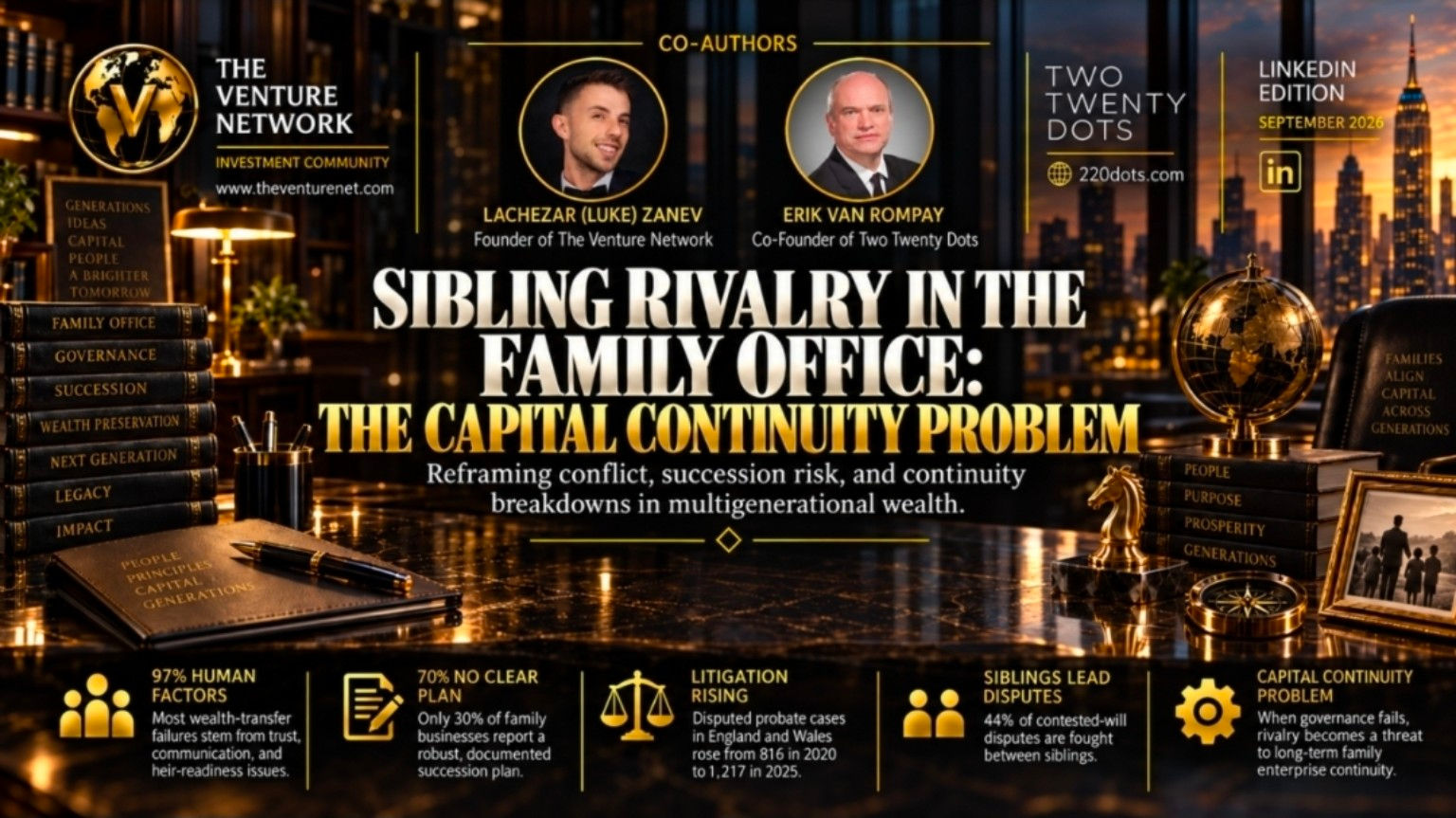
Sibling Rivalry in the Family Office: The Capital Continuity Problem

VN INTELLIGENCE · FAMILY OFFICE GOVERNANCE · SEPTEMBER 2026
Why sibling conflict becomes a capital-continuity risk when governance, ownership and succession remain ambiguous.
Lachezar (Luke) Zanev · Founder, The Venture Network | Erik Van Rompay · Co-Founder, Two Twenty Dots
Executive summary
Sibling conflict is rarely about a single paycheck or dividend. It is often a symptom of unclear roles, ownership, succession and governance inside the family enterprise. |
When intergenerational wealth transitions break down, the immediate explanation is often financial: taxes, investment losses, legal structures or poor estate planning. Yet some of the most persistent research on wealth succession points in another direction. The Williams Group has linked the majority of failed wealth transitions to breakdowns in trust and communication, inadequate preparation of heirs and the absence of shared purpose. Technical failures account for only a small share of the problem.
That matters because sibling conflict inside a family office is rarely just a personal disagreement. Once ownership, employment, dividends and succession are involved, old family dynamics can become embedded in the operating structure of the enterprise.
Key succession signals
 |  |
The anatomy of sibling conflict
Structural before visible
A disagreement may appear to be about compensation, titles or a board seat. Underneath, the real issue may be standing inside the family, perceived parental approval, unclear authority or uncertainty about the future. Ameriprise Financial's 2017 Family Wealth Checkup found that only a minority of siblings reported financial conflict, but when disputes did occur, parents were the trigger in 68% of cases.
In a family enterprise, these emotional dynamics become more consequential because the same people can simultaneously be siblings, shareholders, directors, beneficiaries and employees. A conflict in one role quickly spills into the others.
The paycheck problem
Executive compensation is one of the most obvious flashpoints. One sibling may work full time in the operating company while another remains a passive shareholder. The active sibling may believe salary and bonuses should reflect responsibility and performance. The passive sibling may view the same compensation as value being extracted from an asset they also own.
The dispute is rarely solved by simply choosing a number. Families need a compensation policy that distinguishes payment for work from return on ownership. Market-based salaries, independently approved bonuses and a separate dividend policy can remove much of the ambiguity.
The unwanted succession
Birth order can create another problem. The eldest child may be assumed to be the natural successor even when another sibling is better prepared, more motivated or more suited to leadership. Sometimes the presumed successor does not even want the role.
This is where informal expectations become dangerous. PwC's Global Family Business Survey 2021 found that only 30% of family businesses globally had a robust, documented and communicated succession plan. When the path is not explicit, every promotion, meeting invitation and delegation of authority can be interpreted as evidence about who the founder really intends to choose.
Active owners and passive owners
A sibling running the company often prioritizes reinvestment, hiring, acquisitions and long-term growth. A sibling whose wealth is concentrated in the same family asset but who does not work in the business may prioritize dividends, liquidity and diversification.
Neither position is inherently irrational. The problem is trying to resolve two different economic objectives without a policy for doing so. A family office needs clarity around dividend policy, liquidity mechanisms, reinvestment thresholds and the circumstances under which a shareholder can sell or reduce exposure.
What siblings are really competing for
Many sibling disputes are ultimately arguments about position. Who is trusted? Who gets access to the founder? Who represents the family externally? Who controls capital allocation? Who will chair the board? Who is seen as the keeper of the family's legacy?
When these questions remain unanswered, small operational decisions acquire symbolic weight. A routine promotion can become a referendum on family status. An invitation to an investment committee can feel like a declaration of succession. Undefined structures give personal grievances a business issue to attach themselves to.
Once ownership, employment, dividends and succession are involved, old family dynamics can become embedded in the operating structure of the enterprise. |
When conflict becomes litigation
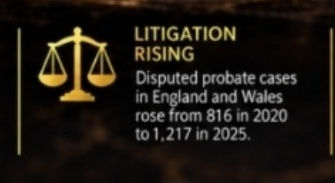
When unresolved family tension moves beyond the boardroom, it can become a public inheritance or probate dispute. The original LinkedIn edition highlighted the rise in disputed probate filings and the unusually high share of contested-will disputes involving siblings.
 |  |
Build the governance architecture before the conflict
Good governance does not eliminate emotion. It prevents emotion from being the only decision-making mechanism available. Families can reduce the number of ambiguous situations by documenting who decides what, how disputes are escalated and which decisions require independent input.
At minimum, that architecture should separate four questions: governance, authority, ownership and continuity. Governance defines where disagreement is discussed. Authority defines who has the right to make which decisions. Ownership defines economic rights, liquidity and distributions. Continuity defines how leadership and control move from one generation to the next.
Four questions every family office should separate
GOVERNANCE Where disagreement is discussed and resolved | AUTHORITY Who has the right to make which decisions |
OWNERSHIP Economic rights, liquidity and distributions | CONTINUITY How leadership and control pass to the next generation |
What if the family cannot agree?
The preferred outcome is usually an internal solution that preserves both the enterprise and the relationships around it. But not every family can or should force all siblings into the same operating structure.
Separate operational responsibility — One option is to separate operational responsibility. Different family members can take responsibility for different businesses or investment areas while common ownership remains governed at the holding-company level. Another is to recruit an external CEO for the family office or operating group, with the family acting through a board rather than through competing executive roles.
Introduce independent leadership and mediation — Independent directors, mediators and advisers can also be useful, particularly where trust has already deteriorated. Their value is not that outsiders understand the family better than the family understands itself. Their value is that they can create a neutral process when every internal decision is being interpreted through decades of history.
Capital continuity is governance continuity
The central lesson is simple: succession cannot be treated as a document signed at the end of a founder's career. It is a long process of clarifying roles, preparing heirs, distributing authority and building decision-making habits that can survive the founder.

Families that document decision rights, define ownership policies and create visible succession paths reduce the ambiguity that feeds sibling conflict. The result is not only better continuity of capital. It is a better chance of preserving the family relationships that the capital was meant to support in the first place.
Key takeaways
Sibling disputes often reflect unclear roles and authority rather than purely financial disagreement.
Compensation for work and return on ownership should be governed separately.
Succession becomes less destabilizing when decision rights and leadership paths are visible before a founder steps back.
Governance, authority, ownership and continuity need distinct rules if a family enterprise is expected to survive across generations.
Sources & further reading
The Williams Group — multigenerational wealth transition and family-enterprise research
PwC — Global Family Business Survey 2021
Ameriprise Financial — 2017 Family Wealth Checkup
Key sources referenced in this analysis include The Williams Group's work on multigenerational wealth transition and family-enterprise fault lines; PwC's Global Family Business Survey 2021; and Ameriprise Financial's 2017 Family Wealth Checkup research on sibling financial conflict.
Originally published on LinkedIn on September 14, 2026. This website edition has been adapted and expanded for The Venture Network.
THE VENTURE NETWORK Private investment community connecting investors, entrepreneurs, family offices and dealmakers across asset classes, sectors and borders. |


Comments